



WRONG NOTES: a blog of ear reverence
Wrong Notes collects posts on music, art, culture and fun stuff. Also included: news about the Ear Reverends.
Packaging Err or Man
Getting into the art of packaging—I mean, literally, putting things in packages.
Packaging up copies of Err or Man is proving to be a nice lot of work. Mostly it’s the limited edition copies, which have extra objects in the bag and hand drawings and signatures. But, this first batch going out (both limited editions and first editions) is almost all wrapped-up and ready to go! And, then, going forward, I think I’ve got the hang of what I’ll have to call the Err or Man packaging process when we launch Err or Man Industries (just kidding).
Some pix:
Front of a limited edition package
(next to a classic photo of Soren Alderson and Bernard Bernard)

Back of a limited edition package

Desk during packaging, and a stack of finished packages


You might recognize a box on the desk as being the Steve Reich 1965-1995 box set, which I love and am enjoying listening to all 10 CDs of again right now. If you know Reich’s music, you can imagine me packing up Err or Man bags while listening to “Drumming” and “Music for 18 Musicians.”

Got the Err or Man books today!
The first batch of the Err or Man books are here.
HereJam studio has been temporarily converted to an assembly room, as we put together the books and CDs. Finally! For the folks who already have ordered Err or Man, your copies will be going out soon. And, then we'll have Err or Man ready for public release, too!
End of old, start of new
So, pretty much exactly six months since my last post here. . . Since then, I've figured it out.
So, now it's in the works. Next couple months, you'll see:
The new "debut" Ear Reverends' album, Err or Man: featuring 20 new songs and, generally, more stuff that's like the proverbial bag o' surprises.
The new Ear Reverends website: for all of you Ear Reverends to call home (or, you know, whatever you would want to call it).
The new Wrong Notes: a totally new format, "the blog of ear reverence," for group text / audio / video / photo posting on music, art, culture and stuff of interest and delight to Ear Reverends across the cosmos.
Probably not many peeps until it's new. But, then, I'll be seeing y'all here!
Podcast, The Worst Song Ever
As a kid, my cousin Dean Fienberg and I had a band called "The Light." We played together as a band for a couple years, had a bunch of songs, and even played a show at a good sized club in LA, called Hop Singhs.
But, most important in the history of things: in 1983, we created and recorded what we now realize to be The Worst Song Ever. In honor of this lowly achievement, I've compiled a podcast that includes this song, called "Dark Is the Night," as well as a funny conversation between Dean and me about why it's so bad.
I've also include two new Wrong Notes tracks—so check-out some new Ear Reverends' music too.
(So, the podcast is available in a so-called RSS Podcast feed, if you know what that is. But all of the contents are also available via these links and player below. Note that the individual tracks linked below are higher quality than the all-in-one podcast track.)
~~~
Wrong Notes Podcast #02
- Talking: Introduction [1:16]
- Music: Spy? Music (new, for Wrong Notes) [1:45]
- Talking: A Little History [0:46]
- Music: New Dawn Coming, by The Light [3:32]
- Talking: Segue into Dark Is The Night [0:48]
- Music: Dark Is The Night, by The Light (The Worst Song Ever) [7:38]
- Talking: Conversation with Dean Fienberg [7:42]
- Music: Nostalogia (new, for Wrong Notes) [1:38]
- Talking: Colophon [0:24]
Or, play it all now! Here!
~~~
Whew! Done with that nostalgia trip. Now back to working on the Err or Man album.
Returning, and forward
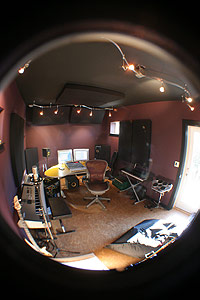
It's a long story, everything I've done instead of blogging here for a while. The big things: the new Ear Reverends album "Err or Man" is in the works, the new HereJam studio is up and running, and the new HereJam record label is coming together.
I also finished the preliminary remix / remaster of the five tapes of jams of Slobot, a collaboration from 1986 of Bernard Bernard, Eduard Margidan and myself. I am looking to release a "best of" Slobot compilation this year (joint HereJam / Picayune release).
I have a new podcast coming very soon. But, for today's music, I'll include a link to the Slobot page on the Bernard Bernard site. Click through and play the Slobot tracks there.
more soon!
Podcast, conversation with Bre Pettis (Make Blog), new Wrong Notes
This is the first of the new Wrong Notes podcasts, now with both talking and music.
In this edition I play some new Wrong Notes music and talk with Bre Pettis, host of the MAKE Podcast, about our collaboration—the Ear Reverends created the theme music for MAKE Podcast's opening credits.
(We also briefly talk about and hear some sounds from the wonderful Casio VL-Tone synthesizer / calculator.)
Here's a link to the complete show in a single mp3 [14:22]. This is what you'll get if you subscribe to this blog's RSS feed and your feed reader is podcast enabled. (Also, it's available via iTunes.)
Now, I've always wanted this now-named podcast technology to support playlists, but it doesn't (yet, at least not consistently). So, I am also making available the podcast in playlist versions: here's the complete show as a XSPF playlist and the complete show as a m3u playlist. I am also including links to the individual files, below.
The individual mp3s in the playlist version (and below) are higher quality, and there's also an extra "bonus track" at the end of the playlist (more conversation with Bre about what he's up to next with the MAKE Podcast). So, if you are playlist enabled, definitely check out the playlist version!
- Talking: Introduction [0:55]
- Music: Oh Snap (new, for Wrong Notes) [0:58]
- Talking: Conversation with Bre Pettis, part 1 [2:35]
- Music: I Make Things (Ring) [0:48]
- Music: MAKE Podcast Theme, first sketch [0:11]
- Talking: Conversation with Bre Pettis, part 2 [1:02]
- Music: MAKE Podcast Theme, second sketch [0:11]
- Talking: Conversation with Bre Pettis, part 3 [0:54]
- Music: MAKE Podcast Theme, final version [0:14]
- Talking: Conversation with Bre Pettis, part 4, and Closing [1:49]
- Music: Other Ducks (new, for Wrong Notes) [4:27]
- Talking: Colophon [0:18]
- Extra Bonus (playlist only) Talking: Bre on what he's up to next and robots [3:10]
Here's a XSPF player to play it, too:
~~~
Attention! This podcast also comes with a one-time-only special feature: free high-pitched hardrive noise in the background during some of the talking segments. Absolutely Free! This incredible offer won't be repeated. The high-pitched hardrive noise will not appear in future podcasts. So, be sure not to miss it in this one—listen now before it's too late!
Wing Drops, from Blood Drive
Following-up on my last post, included here is "Wing Drops", another early, rough mix instrumental from Blood Drive. Listen and enjoy!
~~~
Since starting work on Err or Man, the upcoming Ear Reverends' album, I've now ended the Practices series. I actually completed one more, last piece in the series, called "I Make Things" (using the voice of the artist Bre Pettis).
But I probably won't directly release the "I Make Things" song (I think I'll do something with it in an upcoming podcast).
Fortunately, the song started a conversation between Bre and me that has led to the Ear Reverends creating the theme music for Bre's new video series for Make magazine. More about that soon—I think the series launches next Tuesday (May 2nd)!
~~~
I've got a few other music projects happening beyond Err or Man, and I'll just have to wait until time is right to announce them.
But, I can mention now that we're getting close to starting construction on the new HereJam Studio (yay!). And, also, I'll be expanding the roster of HereJam Records to include at least one other, very neat, musician-artists, whose record(s) I am set to produce.
~~~
By the way, there's an Ear Reverends' My Space now. Since I don't have comments turned on here, if you are on My Space, add the Ear Reverends as a friend and leave us some comments there.
Wiper Away, and more to say
Hey! Guess what? Since my previous post, I started working on a totally new Ear Reverends' album.
This album is now shown under "forthcoming" on the home page—it's called Err or Man, and I've been busy writing and recoding demos (there are about 15 songs).
~~~
Before starting work on Err or Man, I made the tough decision to put on hold Blood Drive—the Ear Reverends' album that was past due. I needed a fresh start on something new.
So, I let go of Blood Drive and then found out that I still really like the album—so, there's a decent chance I'll come back to it and release in the future. But, Err or Man is the big focus right now.
~~~
I've released two early, rough, mixes of instrumentals from Blood Drive. The first, "Wiper Away", is included here (and I'll do another blog post for the second right away). Listen and enjoy.
These are pretty rough in various ways, but I wanted to have at least some of Blood Drive out there before Err or Man.
~~~
I am re-thinking how I use this blog, and am considering doing a more conventional "podcast" with some talking along with the music. This would be a way to tell you about what's happening in the process of creating Err or Man (and other projects), and letting you hear the work in progress.
So, keep an ear out here for more and new things. (Oh, and I'll be re-doing the site at some point too—I have a new design in the works ;-)
« First < 9 10 11 12 13 > Last »
nearby posts:
Wrong Feeds

Wrong Pasts
- September 2018
- August 2018
- April 2011
- March 2011
- December 2010
- November 2010
- October 2010
- September 2010
- August 2010
- July 2010
- June 2010
- May 2010
- April 2010
- March 2010
- February 2010
- January 2010
- December 2009
- November 2009
- October 2009
- September 2009
- August 2009
- July 2009
- June 2009
- May 2009
- April 2009
- March 2009
- February 2009
- January 2009
- December 2008
- November 2008
- October 2008
- September 2008
- August 2008
- July 2008
- June 2008
- May 2008
- September 2007
- February 2007
- January 2007
- June 2006
- April 2006
- October 2005
- September 2005
- December 2004
- October 2004
- September 2004
- August 2004
- July 2004
- June 2004
- May 2004
- April 2004
- March 2004
- February 2004
